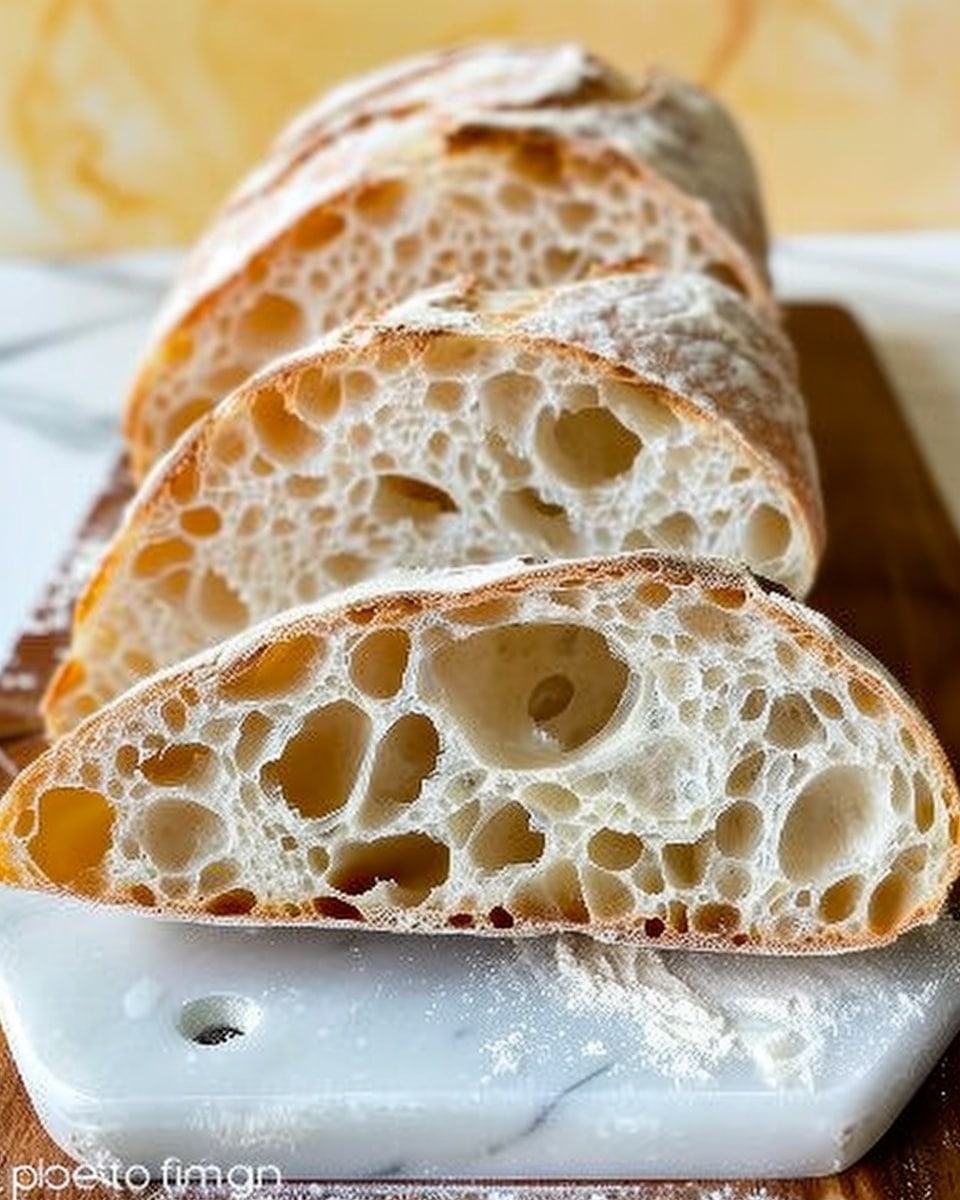
This homemade Italian ciabatta bread delivers a beautifully crisp crust with a soft, airy interior full of delicate holes. It’s a rustic bread that looks impressive yet uses only a handful of simple ingredients. Perfect for sandwiches or dipping in olive oil, this recipe brings bakery-quality bread right into your kitchen.
Why You’ll Love This Recipe
Ciabatta bread stands out for its unique texture and flavor. The crust bakes to a golden crisp while the inside remains light and chewy, making every bite satisfying. This recipe is approachable even for beginners because it relies on a stretch-and-fold method instead of heavy kneading.
Another reason to love it is its versatility. You can serve it warm with olive oil, use it for sandwiches, or toast it for breakfast. The dough may feel sticky at first, but that’s exactly what creates the signature airy crumb.
Ingredients
(Tip: You’ll find the full list of ingredients and measurements in the recipe card below.)
Start by preparing the dough. In a large mixing bowl, combine the bread flour, salt, and yeast. Slowly pour in the warm water and mix using a wooden spoon until a sticky dough forms. Cover the bowl and let it rest for 30 minutes to hydrate the flour.
Next comes the stretch-and-fold process. With slightly wet hands, gently pull one side of the dough upward and fold it over itself. Rotate the bowl and repeat this process on all four sides. Cover and let it rest for another 30 minutes. Repeat this folding step two more times, allowing the dough to rest between each round.
After completing the folds, let the dough rise for about 1 1/2 to 2 hours until it doubles in size. This fermentation step is essential for developing flavor and texture.
Once risen, transfer the dough onto a lightly floured surface. Be careful not to deflate it. Divide the dough into two equal portions and gently shape them into rough rectangles. Place the pieces onto a parchment-lined baking sheet and let them rest for 30 to 45 minutes.
Preheat your oven to 230°C (450°F). For a crisp crust, you can place a tray of hot water in the oven to create steam. Bake the loaves for 20 to 25 minutes until golden brown. Allow them to cool on a wire rack before slicing.
Servings and timing
This recipe makes 2 small loaves, serving about 6 people.
Prep time: 25 minutes
Rise time: about 3 hours
Cooking time: 25 minutes
Total time: approximately 3 hours 50 minutes
Variations
You can easily customize ciabatta bread to suit your taste. Add dried herbs like rosemary or thyme to the dough for extra flavor. For a richer taste, drizzle a bit of olive oil into the dough mixture.
If you prefer a softer crumb, substitute part of the bread flour with all-purpose flour. You can also shape the dough into smaller rolls instead of loaves for individual servings.
For a deeper flavor, let the dough rise slowly in the refrigerator overnight using cold water instead of warm.
Storage/Reheating
To store ciabatta bread, keep it at room temperature wrapped in a clean towel or placed in a paper bag. This helps maintain the crisp crust. It will stay fresh for 2 to 3 days.
For longer storage, freeze the bread once it has completely cooled. You can freeze it whole or sliced. When ready to use, reheat in the oven at 180°C (350°F) for about 10 minutes or toast slices directly.
Avoid storing in plastic bags, as this softens the crust.
FAQs
What makes ciabatta bread different from other breads?
Ciabatta has a very wet dough, which creates its airy structure and chewy texture.
Can I use all-purpose flour instead of bread flour?
Yes, but the texture may be slightly softer and less chewy.
Why is my dough so sticky?
Ciabatta dough is meant to be sticky. This is key to achieving its open crumb.
Do I need a mixer for this recipe?
No, the dough is mixed by hand using a spoon and folding technique.
How do I get a crispy crust?
Adding steam to the oven during baking helps develop a crisp crust.
Can I make one large loaf instead of two?
Yes, just increase the baking time slightly.
Why didn’t my bread have large holes?
Over-handling the dough or insufficient rising time can reduce air pockets.
Can I refrigerate the dough overnight?
Yes, this enhances the flavor and makes the dough easier to handle.
How do I know when the bread is done?
The crust should be golden brown and sound hollow when tapped.
Can I use this bread for sandwiches?
Absolutely, ciabatta is excellent for sandwiches due to its structure.
Conclusion
Italian ciabatta bread is a rewarding recipe that combines simplicity with impressive results. With its crisp crust and soft interior, it’s a versatile bread that fits any meal. Once you get comfortable handling the sticky dough, you’ll find yourself making it again and again.