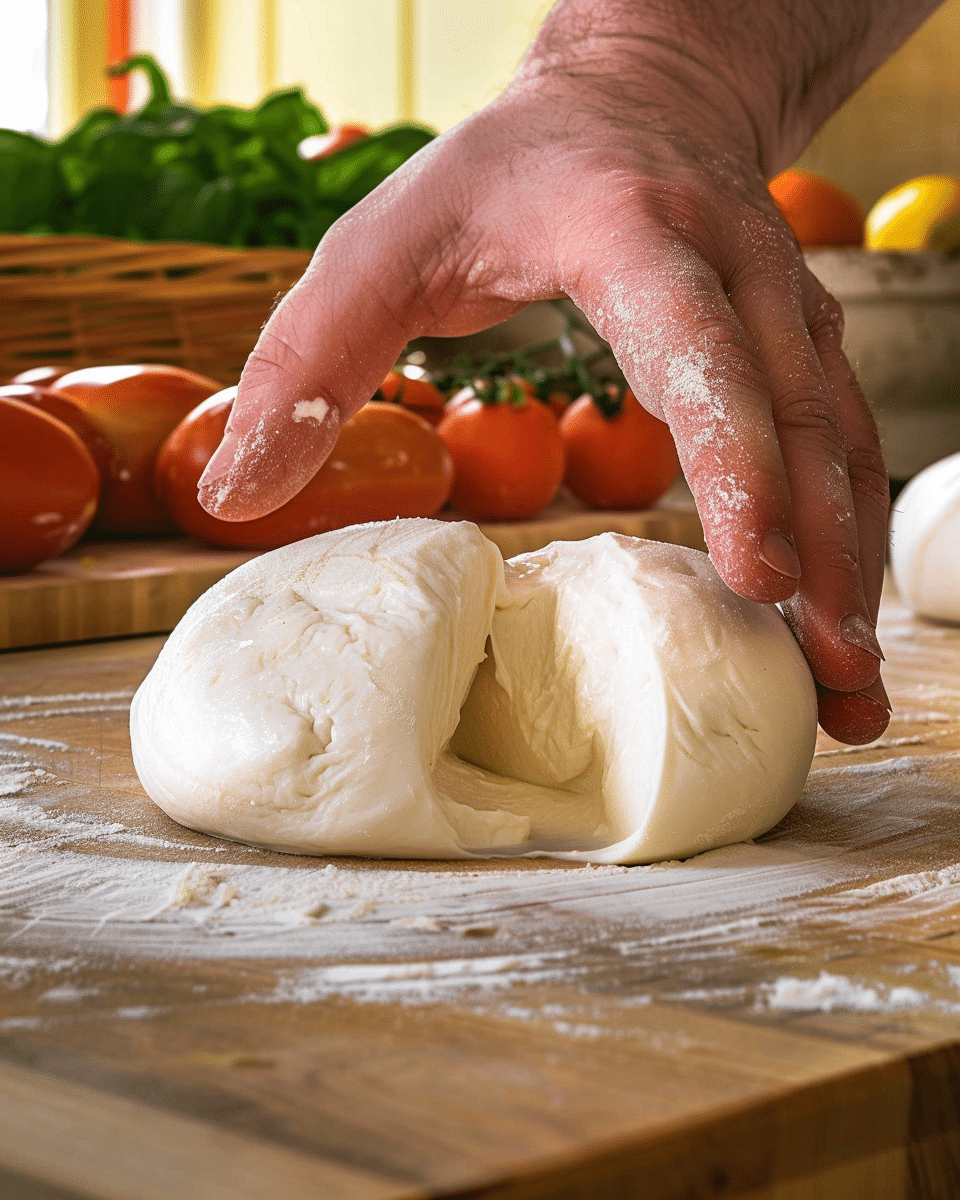
This fresh homemade mozzarella is tender, milky, and delicately creamy—the kind you normally only find warm from an artisan dairy. With just a few simple ingredients and some gentle handling, you can create beautifully smooth mozzarella at home in under an hour.
Why You’ll Love This Recipe
It uses just four simple ingredients.
Ready in about 1 hour from start to finish.
Produces incredibly fresh, soft, stretchy mozzarella far superior to store-bought.
A great beginner-friendly cheese recipe—no special equipment beyond a thermometer and gloves.
Perfect for salads, sandwiches, appetizers, or enjoying warm with a sprinkle of salt.
Ingredients
(Tip: You’ll find the full list of ingredients and measurements in the recipe card below.)
1 gallon (3.8 L) non-homogenized, low-temperature-pasteurized whole milk
1 1/2 teaspoons citric acid
1/4 teaspoon liquid rennet, diluted in 2 tablespoons (30 ml) filtered or distilled water
1 tablespoon (12 g) kosher salt
Directions
Pour the milk into a large stainless steel pot and whisk well to evenly disperse the butterfat. Sprinkle in the citric acid and stir for at least 15 to 30 seconds until fully dissolved.
Over medium-low heat, warm the milk to 88°F (31°C), stirring occasionally. Add the diluted rennet and stir thoroughly for 30 seconds. Reduce heat to low and continue heating until the whey reaches 105°F (41°C), about 3 to 5 minutes. Remove from heat and let stand 5 to 10 minutes.
Use a slotted spoon to transfer the curds to a fine-mesh strainer set over a bowl. Press gently to release excess whey. Allow to drain 10 to 15 minutes until no longer dripping. Transfer the curds to a cutting board, then slice into 1-inch cubes and divide into three portions.
Season the remaining whey in the pot with the kosher salt and stir to dissolve. Transfer one-third of the salted whey to a heat-safe bowl and reserve for resting the mozzarella later.
Heat the remaining whey in the pot to 180°F (82°C). Place one portion of curds into a heatproof bowl and ladle in enough hot whey to fully cover them. Let sit 15 to 20 seconds until the curds soften and begin to cling together.
(Alternatively, microwave one portion of curds for 15-second intervals until soft and stretchy.)
Wearing clean heat-resistant gloves, lift the warm curd mass and gently allow it to stretch as you separate your hands. Do not knead or tear—stretch only as gravity allows. Fold the curd over itself and reheat in hot whey as needed until it becomes smooth, shiny, and elastic.
Shape the stretched curd into a ball by folding it into a palm-sized bundle, then pushing it through a C-shape made by your thumb and forefinger to create a smooth sphere. Pinch off excess. Repeat with remaining portions.
Place each mozzarella ball into the reserved room-temperature salted whey and let rest for 20 to 30 minutes before serving.
Servings and timing
Serves: 6 to 8
Makes: 3 medium mozzarella balls
Prep time: 10 minutes
Cook time: 20 minutes
Active time: 30 minutes
Resting time: 30 minutes
Total time: 60 minutes
Variations
Add herbs: Mix finely chopped basil, parsley, or oregano into the curds just before stretching for flavored mozzarella.
Make bocconcini: Shape smaller, egg-sized balls instead of large rounds—perfect for salads and appetizers.
Smoked mozzarella-style finish: After resting, briefly chill the mozzarella and then give it a quick exposure to mild kitchen-safe smoke for a delicate smoky note.
Marinated mozzarella: Store the finished balls in olive oil with garlic, herbs, and chili flakes for a fragrant appetizer.
Storage/Reheating
Fresh mozzarella is best eaten within a few hours.
To store, wrap each ball tightly in plastic wrap and refrigerate for up to 2 days.
To reheat and restore its tender texture, submerge the mozzarella in warm (not hot) salted water or whey for a few minutes before serving. Do not microwave, as it will cause toughening.
FAQs
How long does homemade mozzarella stay fresh?
It’s best enjoyed the same day but can be refrigerated for up to 2 days when tightly wrapped.
Can I freeze fresh mozzarella?
Freezing affects texture and is not recommended for fresh, high-moisture mozzarella.
Why won’t my curds form properly?
This usually happens when the milk is ultra-pasteurized or homogenized. Low-temperature-pasteurized, non-homogenized milk works best.
Can I use skim or low-fat milk?
No, the cheese will not stretch properly. Whole milk is necessary for creaminess and structure.
Can I substitute lemon juice or vinegar for citric acid?
Citric acid provides consistent acidity; using lemon or vinegar may alter texture and yield.
Why is my mozzarella rubbery?
Resting the cheese in ice water or over-stretching the curds can create a rubbery texture. Use room-temperature whey instead.
Can I make this recipe without gloves?
Gloves are strongly recommended because the curd is handled in very hot whey.
What should I do with leftover whey?
Use it for soups, bread making, soaking grains, or as the heating liquid for additional batches of mozzarella.
Can I double the recipe?
Yes, as long as your pot is large enough and you scale the rennet and citric acid precisely.
Why is my mozzarella too soft?
It may not have been rested long enough, or it may need a slightly hotter whey temperature during stretching.
Conclusion
Homemade mozzarella is surprisingly quick, satisfying, and far more flavorful than anything store-bought. With good-quality milk and a gentle touch, you can create beautifully soft, stretchy cheese perfect for salads, sandwiches, or simply enjoying warm with a sprinkle of salt. Once you try making it yourself, you may never go back to packaged mozzarella again.
This fresh homemade mozzarella is soft, milky, and delicately creamy—made with just four ingredients and ready in under an hour. It’s a beginner-friendly recipe for creating artisan-quality cheese at home, perfect for salads, sandwiches, and appetizers.
1/4 teaspoon liquid rennet, diluted in 2 tablespoons (30 ml) filtered or distilled water
1 tablespoon (12 g) kosher salt
Instructions
Pour the milk into a large stainless steel pot and whisk to evenly distribute the butterfat. Add citric acid and stir for 15–30 seconds until dissolved.
Heat the milk over medium-low to 88°F (31°C), stirring occasionally. Add diluted rennet, stir for 30 seconds, then continue heating to 105°F (41°C). Remove from heat and let rest 5–10 minutes.
Using a slotted spoon, transfer curds to a strainer over a bowl. Gently press to release whey and let drain for 10–15 minutes. Slice drained curds into 1-inch cubes and divide into three portions.
Add kosher salt to the whey in the pot and stir to dissolve. Transfer one-third of the salted whey to a bowl and reserve for resting the mozzarella later.
Heat remaining whey to 180°F (82°C). Place one portion of curds in a bowl and cover with hot whey. Let sit 15–20 seconds to soften.
With heat-resistant gloves, lift and gently stretch the curd until smooth and elastic. Reheat as needed in hot whey. Repeat with remaining portions.
Shape each portion into a ball by folding and smoothing it into a round shape. Pinch off any excess curd.
Place mozzarella balls into reserved room-temperature salted whey and let rest 20–30 minutes before serving.
Notes
Use whole milk that is not ultra-pasteurized for best results.
Add herbs like basil or oregano before stretching for flavored mozzarella.
Store in salted water or whey to maintain texture.
Don’t over-stretch to avoid rubbery texture.
Microwaving is an alternative to hot whey for softening curds.